A decade ago, if you mentioned electric cars, one name came to mind instantly: Tesla. It wasn’t just a car company — it was a symbol of the future, proof that electric vehicles could be fast, desirable, and genuinely cool. But somewhere along the way, a quieter competitor from China started closing the gap, and then, in terms of pure sales numbers, overtook it. That company is BYD — Build Your Dreams — and today, the Tesla vs. BYD rivalry has become one of the most fascinating stories in the entire auto industry.
So who actually comes out on top? The honest answer is: it depends what you’re looking for. Let’s break down how these two EV giants really compare.
The Origin Story: Innovation vs. Scale
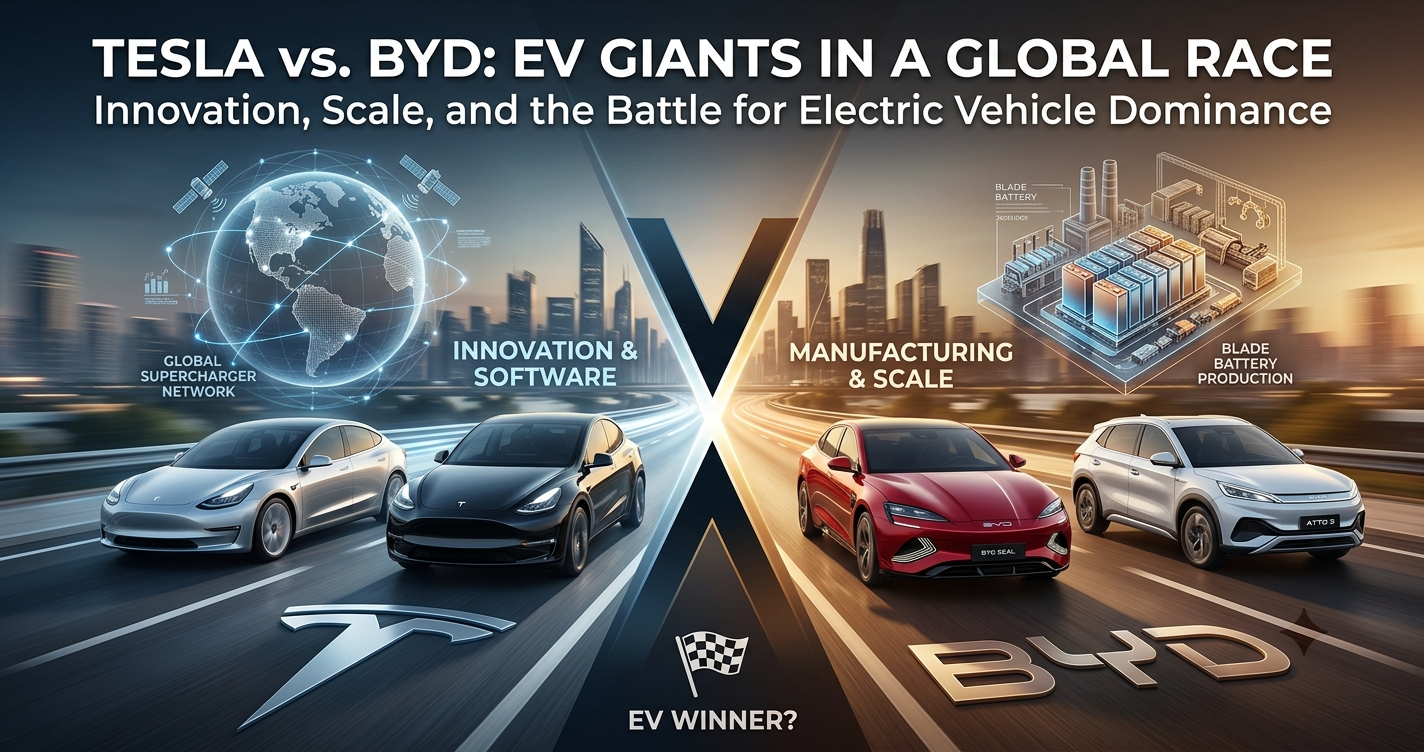
Tesla built its identity around innovation. Founded with the mission to accelerate the world’s transition to sustainable energy, it didn’t just build electric cars — it built a brand. Sleek design, over-the-air software updates, a minimalist interior, and a direct-to-consumer sales model turned Tesla into a cultural phenomenon as much as an automaker.
BYD’s story is different. It started as a battery manufacturer before moving into vehicles, which gives it a unique advantage: it controls much of its own supply chain, including battery production. While Tesla focused on disruption and brand image, BYD focused on manufacturing scale, affordability, and vertical integration. That difference in DNA still shapes how each company operates today.
Sales Numbers: The Shift in Power
For years, Tesla was the undisputed leader in global EV sales. But BYD’s aggressive expansion — fueled by a wide range of vehicles at different price points — allowed it to overtake Tesla in total new energy vehicle sales, which include both fully electric cars and plug-in hybrids. When you narrow the comparison to purely battery-electric vehicles, the race between the two companies has been remarkably close, with the lead shifting back and forth depending on the quarter.
This matters because it shows two very different strategies working at scale. Tesla sells fewer models but focuses on premium positioning and strong margins. BYD sells a much broader lineup, targeting everyday buyers with a wide range of price points, from compact city cars to luxury sedans.
Technology and Innovation
Tesla still holds a strong reputation for software. Its Autopilot and Full Self-Driving systems, while not fully autonomous, are considered among the most advanced driver-assistance technologies available in a consumer vehicle. Tesla’s over-the-air update system also means the car keeps improving long after you drive it off the lot — new features, performance tweaks, and safety upgrades delivered straight to your vehicle’s software.
BYD, on the other hand, has focused heavily on battery innovation. Its Blade Battery technology, built on lithium iron phosphate (LFP) chemistry, is known for being safer, more thermally stable, and longer-lasting than some traditional lithium-ion batteries. BYD has also been rapidly expanding its own driver-assistance and smart cabin technology, closing the software gap that once clearly favored Tesla.
In short: Tesla has traditionally led on autonomous driving software, while BYD has led on battery engineering and manufacturing efficiency. Both companies are now racing to catch up in the other’s strength zone.
Design and Model Range
Tesla’s lineup is relatively focused — the Model 3, Model Y, Model S, and Model X, alongside the Cybertruck, cover a narrow but well-defined range of vehicle types. The design language is consistent: minimalist, tech-forward, and instantly recognizable.
BYD’s model range is far more diverse. From affordable hatchbacks to the luxury-focused Yangwang sub-brand, BYD covers a much wider spectrum of the market. This diversity allows BYD to reach a broader base of buyers, particularly in regions where affordability plays a bigger role in the buying decision than brand prestige.
Pricing and Accessibility
This is where the comparison becomes especially interesting. Tesla vehicles, while more affordable than they once were, still generally sit in the mid-to-premium price bracket. BYD, by contrast, has built its reputation on offering electric vehicles at a wide range of price points, including some of the most affordable EVs available globally. This pricing strategy has made BYD an especially strong contender in emerging markets, where cost is often the biggest barrier to EV adoption.
Global Expansion
Tesla built its global presence early, with Gigafactories in the U.S., China, and Europe, and a strong charging network through its Supercharger stations — a network so effective that other automakers have started adopting Tesla’s charging standard. BYD, meanwhile, has been expanding aggressively into Europe, Southeast Asia, Latin America, and the Middle East, positioning itself as a serious global competitor rather than just a domestic Chinese success story.
Which One Should You Choose?
If you value cutting-edge autonomous driving software, a strong resale value, and one of the most extensive fast-charging networks in the world, Tesla remains a compelling choice. It’s a brand built on pushing boundaries, and that spirit still shows in how the cars drive and feel.
If affordability, battery safety, and a wider range of models matter more to you, BYD offers exceptional value. Its rapid innovation cycle and vertically integrated manufacturing mean you’re often getting more car — and more battery technology — for your money.
The Bigger Picture
Ultimately, the Tesla vs. BYD comparison isn’t really about picking a winner — it’s a sign of how far the EV industry has come. A few years ago, there was barely any real competition at this scale. Now, two very different companies, with two very different philosophies, are pushing each other to build better, safer, and more affordable electric vehicles.
And that competition benefits everyone. Whether you lean toward Tesla’s software-driven innovation or BYD’s manufacturing muscle and battery expertise, one thing is clear: the electric vehicle revolution is no longer a one-company story. It’s a global race, and it’s only getting more exciting from here.