Not too long ago, a “smart car” simply meant one with power windows and a decent stereo. Fast forward to today, and modern cars have turned into rolling computers — packed with sensors, cameras, artificial intelligence, and software updates that arrive over the air, just like your phone. If you’ve test-driven a new vehicle recently, you’ve probably noticed it: the car doesn’t just take you from point A to point B anymore. It watches the road, predicts danger, talks back to you, and in some cases, even parks itself.
This shift isn’t a passing trend. It’s a complete transformation of what a car is supposed to be — and it’s only picking up speed.
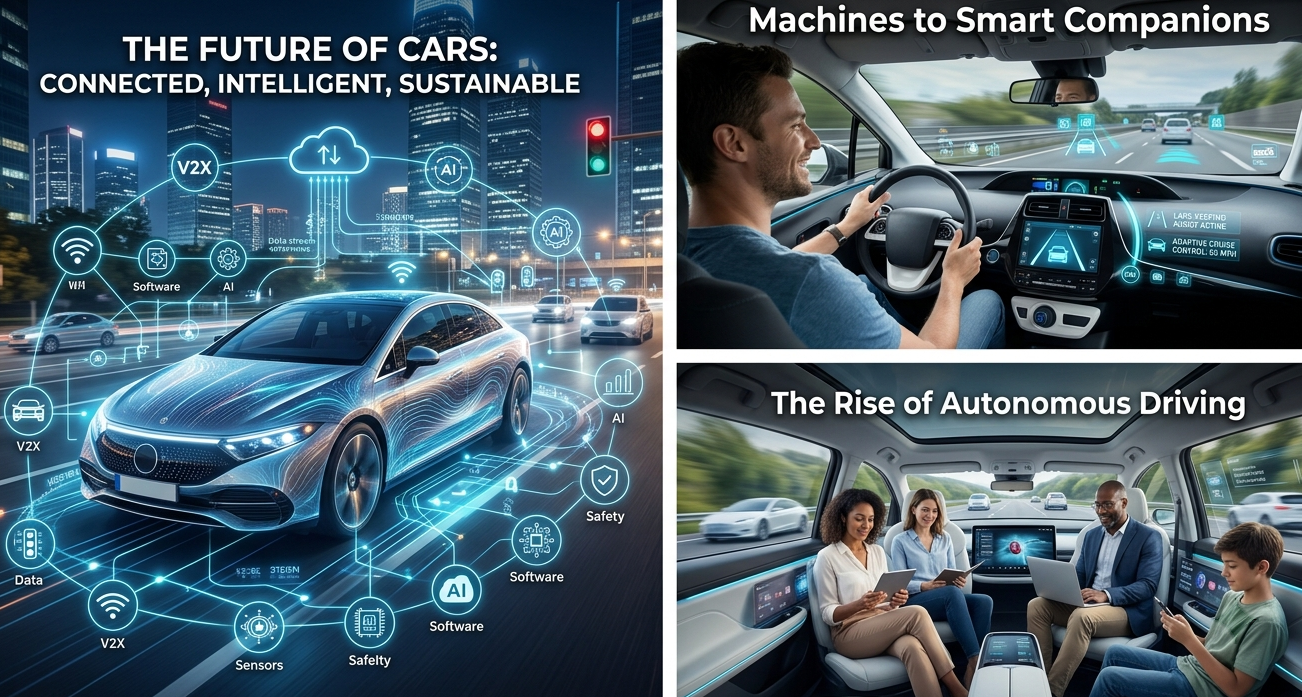
From Machines to Smart Companions
For most of automotive history, a car was purely mechanical: an engine, a transmission, four wheels, and a driver in full control. Today’s vehicles blur that line. Modern cars are equipped with advanced driver-assistance systems (ADAS) — lane-keeping assist, adaptive cruise control, automatic emergency braking, blind-spot monitoring — features that were once reserved for luxury models and are now standard even in budget-friendly cars.
What’s driving this change is a combination of better sensors, cheaper computing power, and smarter software. Cameras and radar units feed real-time data into onboard computers that make split-second decisions, often faster than a human driver could react. It’s not about replacing the driver just yet — it’s about creating a safety net that catches mistakes before they turn into accidents.
And the technology doesn’t stop at safety. Infotainment systems have evolved into full-blown digital ecosystems, complete with voice assistants, smartphone integration, and personalized settings that follow you from car to car. Your seat position, favorite radio stations, and even climate preferences can now sync to your profile, so the car feels like it truly belongs to you — no matter which vehicle you’re sitting in.
Electric Vehicles: The New Normal
No conversation about modern car technology is complete without talking about electric vehicles (EVs). What used to be a niche market dominated by a handful of manufacturers has turned into one of the fastest-growing segments in the entire auto industry. Battery technology has improved dramatically, charging networks are expanding, and prices are gradually becoming more competitive with traditional gasoline-powered cars.
EVs bring more than just a cleaner tailpipe. Their instant torque delivers a driving experience that feels fundamentally different — quick, quiet, and remarkably smooth. Regenerative braking, smart battery management, and software-controlled powertrains mean that an electric car isn’t just a gas car with a battery swapped in; it’s an entirely new kind of machine built around efficiency and digital control.
Hybrid vehicles are also playing a crucial bridging role, offering drivers a taste of electric efficiency without the “range anxiety” that still worries some buyers. Together, EVs and hybrids are steadily pushing the auto industry toward a cleaner, quieter future.
The Rise of Autonomous Driving
Perhaps the most talked-about piece of car technology today is autonomous driving. Self-driving cars once felt like science fiction, but the building blocks are already here. Many modern cars now offer varying levels of automation — from basic driver assistance to systems capable of handling highway driving with minimal input.
Full self-driving, where a car can navigate any road condition without human intervention, is still being refined. Companies are investing heavily in machine learning, LiDAR, and high-definition mapping to make this a reality. The goal isn’t just convenience — it’s safety. Human error is responsible for the vast majority of road accidents, and proponents of autonomous technology argue that removing that variable could save countless lives.
That said, trust takes time. People want to feel confident handing over control, and that confidence is built gradually, through consistent, predictable, and transparent technology — not overnight.
Connectivity: Cars That Talk to the World
Modern cars are no longer isolated machines; they’re connected nodes in a much larger digital network. Vehicle-to-everything (V2X) communication allows cars to “talk” to traffic lights, road infrastructure, and even other vehicles. Imagine a car that knows a traffic light is about to turn red before the driver even sees it, or one that receives real-time alerts about accidents or road hazards miles ahead.
This connectivity also extends to maintenance. Many vehicles can now self-diagnose issues and alert drivers — or even the manufacturer — before a small problem turns into a costly repair. Over-the-air software updates mean your car can literally get better after you buy it, gaining new features or fixing bugs without a single trip to the dealership.
What the Future of Cars Might Look Like
So where is all of this heading? A few things seem certain. Electric powertrains will continue to dominate new car development, supported by longer-lasting batteries and faster charging solutions. Autonomous features will keep expanding, gradually moving from “assistance” to genuine independence on the road. And cars will become even more personalized — adapting to drivers through AI in ways that feel less like using a machine and more like working with a digital partner.
There’s also a strong push toward sustainability. Manufacturers are experimenting with recycled materials, more efficient manufacturing processes, and designs that reduce environmental impact from production to disposal. The future car isn’t just smarter — it’s expected to be kinder to the planet, too.
Interior design is shifting as well. As autonomous features mature, the traditional driver-focused cockpit may give way to more flexible, lounge-like interiors, where passengers can work, relax, or socialize during the ride instead of gripping the wheel.
A Human Perspective on All This Change
It’s easy to get lost in the specs and buzzwords — AI, LiDAR, V2X, autonomous levels — but at the heart of it, all this innovation serves a simple purpose: making our daily drive safer, easier, and a little more enjoyable. Whether it’s a parent who feels safer knowing their car will brake automatically if a child runs into the street, or a commuter who no longer dreads bumper-to-bumper traffic because the car handles most of it, technology is quietly reshaping our relationship with driving.
Change in the auto industry has always happened gradually and then suddenly. We spent decades refining the internal combustion engine, and now, in the span of just a few years, we’re witnessing an entirely new chapter unfold — one defined by electricity, intelligence, and connectivity.
The cars of tomorrow won’t just get us places faster. They’ll understand us better, protect us more reliably, and connect us to a smarter world around us. And honestly, that’s a future worth being excited about.